
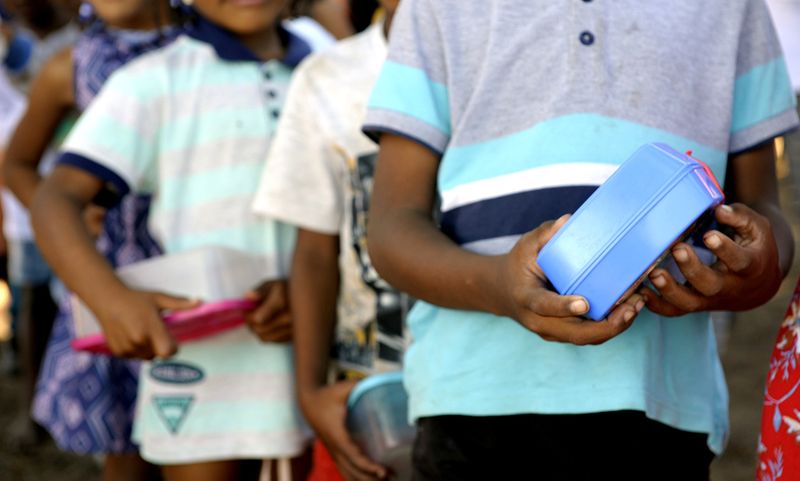
With schools and early learning centres closed for the summer holiday, many children have lost access to feeding programmes and safe play spaces. For caregivers struggling to put food on the table, the community-led initiatives providing support over this period can make a world of difference.
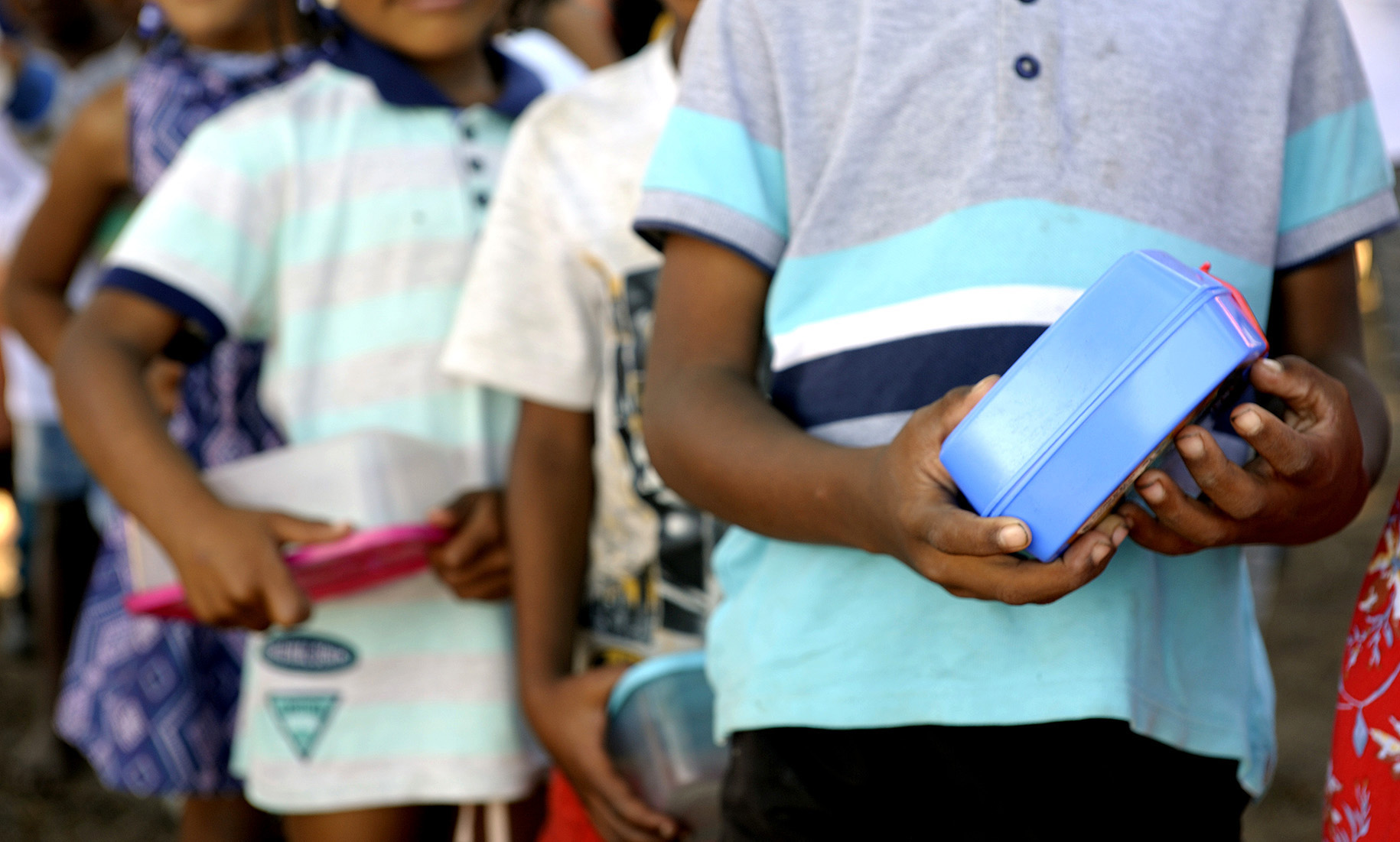 Children queue for food at Compassionate Hearts Soup Kitchen in Touws River, Western Cape. (Photo: Joyrene Kramer)
- Dive Deeper
- Speed Read
- Summary
- Listen

The festive season represents a time of cheer and rest for many, but for others it is rife with challenges. Schools and early learning programmes close down for the summer holiday, taking with them access to feeding schemes and safe play spaces for many thousands of children. For some caregivers, it becomes an uphill battle just to put food on the table.
Professor Eric Atmore, the director of the Centre for Early Childhood Development, pointed out that the ECD Census 2021 found that more than 1.6 million children were enrolled in early learning programmes across the country. He estimated that between 400,000 and 500,000 of these children were likely to be food insecure, based on the UN Children’s Fund figures stating that 23% of children in South Africa lived in severe food poverty.
advertisement
Don’t want to see this? Remove ads
“Our concern with the early childhood development (ECD) centres not operating, is that those children are going to be highly vulnerable to hunger during the school holidays, because often their parents can’t replace what the ECD centre provides,” said Atmore.
/file/dailymaverick/wp-content/uploads/2023/11/GTK_1286.jpg "Centre for Early Childhood Development director Professor Eric Atmore. (Photo: Supplied)")
One ECD programme, the Khumbulani Health, Education and Resource Centre in Khayelitsha, Cape Town, usually looks after 297 children between the ages of six months and six years. Anathi Katsi Katsi, the project coordinator at Khumbulani, said that the closure of the centre during the holiday was challenging for caregivers who continued to work over Christmas and New Year, as well as those battling unemployment.
“We’re thinking of those vulnerable children who are being exposed to the lifestyles of the holidays at this moment, and those who have nothing on their tables because remember, most of the children will come to Khumbulani because they want to have nutrition,” said Katsi Katsi.
“If these programmes are now on hold due to the holidays, what are these children receiving in terms of food during the day, and who is supporting them? Because in the Khumbulani space, they will receive psychosocial support with the care of social workers.”
Khumbulani’s leaders hope to secure funding that would allow them to host a summer holiday programme for children in future, providing much-needed relief to working parents. In the meantime, they have continued to run a soup kitchen from the centre every Tuesday and Thursday.
“We do notice that there are some children… from the Khumbulani aftercare programme who will come to the soup kitchen as well to have those nutritious meals,” said Katsi Katsi.
/file/dailymaverick/wp-content/uploads/2023/11/DSC_9337-copy.jpg "Children can barely wait to sit down before they start eating at the Walmer Angels soup kitchen in Gqeberha, Eastern Cape. (Photo: Deon Ferreira)")
Right to play
Katsi Katsi noted that a lack of safe play areas in Khayelitsha posed an additional risk to children during the holidays, with many young people resorting to playing in the streets.
“When they come to Khumbalani for the soup kitchen, it opens that opportunity [for play]… as they have the playground for ECD. While children are waiting for the soup kitchen to dish up… they will come into that space and play,” she said.
/file/dailymaverick/wp-content/uploads/2024/06/Mother-City-Nkosikhona-Swartbooi.jpeg "Nkosikhona Swartbooi speaks at a Reclaim the City Rally. (Photo: Supplied)")
Concerns about safe play areas during the summer break were also spotlighted by Nkosikhona Swartbooi, the organiser behind the Right to Play Campaign and a long-time housing activist. He noted that the schools where children usually spent most of their time could provide safe and regulated recreational activities.
“That is not the case for our communities. There’s that mismatch in terms of the safety for kids in schools and the safety for kids at home… because most parents work. With most parents coming from poor and working-class communities, particularly the black and coloured communities, children are raised by the street… It puts them in a position of vulnerability in terms of what they get taught,” he said.
Rural communities
In the rural areas, problems of food insecurity and safety among children have long been a challenging feature of the festive season. The Rural and Farmworkers Development Organisation told Daily Maverick it had “consistently observed a noticeable increase in food insecurity among children in rural and farmworker communities during the festive season”.
“When schools and early childhood development centres close, many children lose access to daily meals provided through school nutrition and feeding schemes. For households already facing unemployment, seasonal farm work or low and irregular incomes, this gap places significant pressure on families and often results in reduced meal frequency, poorer nutritional quality and heightened vulnerability for children,” said Rural and Farmworkers Development Organisation founder Billy Claasen.
/file/dailymaverick/wp-content/uploads/2022/07/MC-Ashton_7.jpg "About 500 students at Ashton Secondary School in the Western Cape rely on the school’s nutrition programme. This number has increased significantly in recent years. (Photo: Joyrene Kramer)")
Schools and ECD centres often serve as the primary safe environments for children during the year, according to Claasen. Once they close, many children are left without supervision while caregivers seek seasonal work or manage household responsibilities.
“This increases children’s exposure to risks such as accidents, substance abuse, exploitation and gender-based violence, particularly in under-resourced rural areas,” said Claasen.
The Rural and Farmworkers Development Organisation is running a Christmas project aimed at providing immediate relief to vulnerable children during the end-of-year period. It distributes food parcels and nutritious meals to at-risk households, provides basic necessities such as hygiene packs and warm clothing, and creates safe, child-friendly spaces through community-based activities.